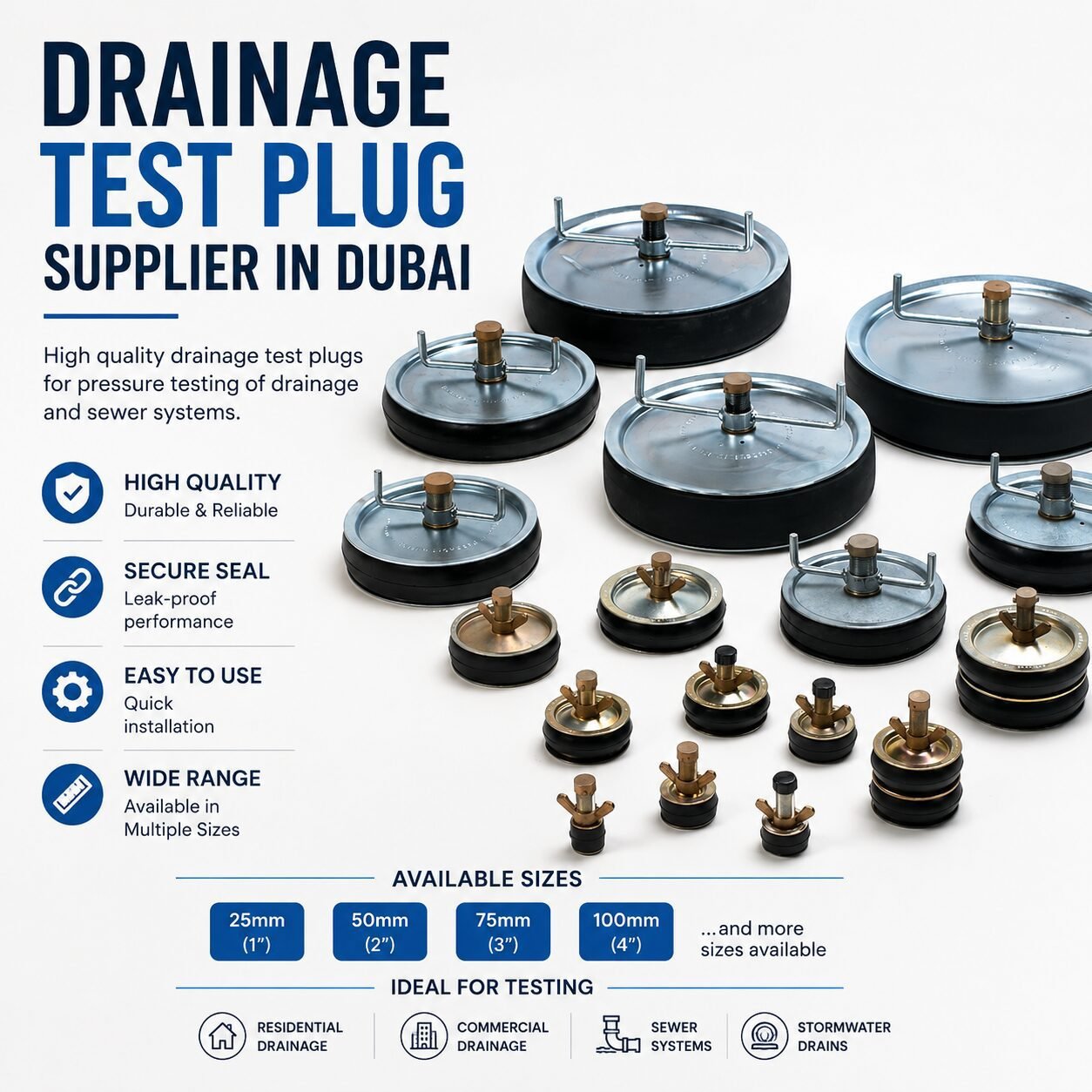
Drainage test plugs are essential tools for plumbing contractors, MEP teams and inspection engineers across Dubai. They are used to pressure-test newly installed drainage and sewer systems, isolate pipe sections for repair work, and verify pipe integrity before handover. Choosing the right test plug size is critical — a plug that is too small leaks, while one that is too large will not seat correctly inside the pipe.
This guide explains test plug sizing for Dubai contractors, covers the standard pipe sizes used across UAE construction and helps you select the right plug for your specific application.
How Drainage Test Plug Sizing Works
Drainage test plugs are sized by the internal diameter of the pipe they seal against. Specifically, a plug rated for 110mm fits inside a pipe with 110mm internal diameter. The plug expands when inflated or tightened, creating a watertight seal against the pipe wall.
Furthermore, every plug has a working pressure rating — typically 0.5 to 3 bar depending on size and type. The pressure rating determines how much water column or pressurised test medium the plug can hold before failing. For most building drainage tests in Dubai (low-pressure water tests for newly installed waste pipes), 0.5 to 1 bar is sufficient.
Standard Pipe Sizes Used in Dubai Drainage Systems
UAE construction follows European and British standards for drainage pipe sizes. The most common nominal pipe sizes used in residential, commercial and industrial drainage are:
- 50mm — washbasin and sink waste pipes
- 75mm — shower waste, secondary branch waste pipes
- 110mm — main soil stack pipes for toilet and WC connections (most common building drainage size)
- 160mm — main building drain, primary horizontal drain runs
- 200mm — building outflow to sewer, commercial drainage
- 250mm to 315mm — main sewer connection pipes
- 400mm to 600mm — public sewer infrastructure, stormwater drainage
Mechanical vs Inflatable Test Plugs
Mechanical Drainage Test Plugs
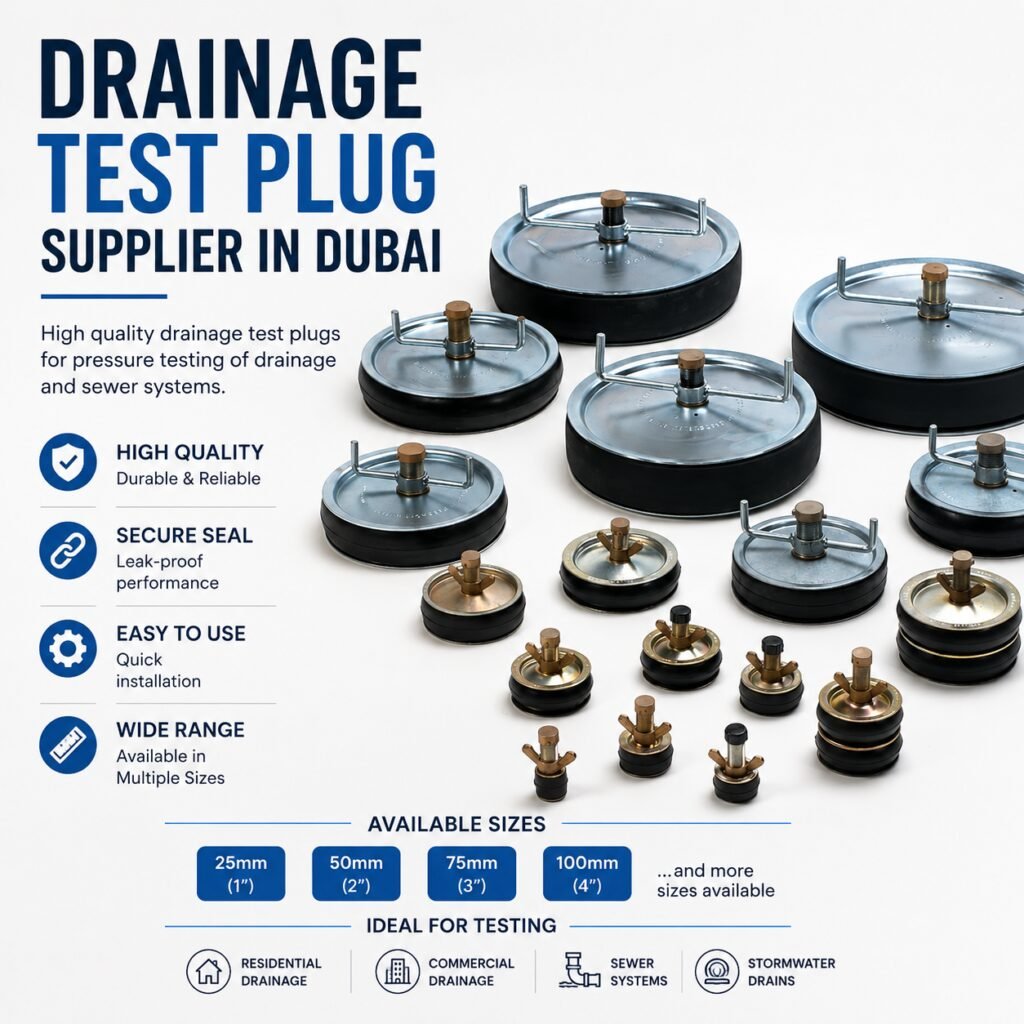
Mechanical plugs use a threaded centre rod that compresses a rubber sealing ring against the pipe wall. Specifically, you tighten the wing nut on the rod which forces the rubber to bulge outward and seal. Moreover, mechanical plugs are reusable, relatively low cost and reliable for standard low-pressure tests. They are the most common choice for residential and small commercial drainage testing in Dubai.
Standard mechanical plug sizes available: 50mm, 75mm, 110mm, 160mm and 200mm. Working pressure typically 1 to 1.5 bar.
Inflatable (Pneumatic) Test Plugs
Inflatable plugs use compressed air or nitrogen to expand a rubber bladder inside the pipe. Furthermore, inflatable plugs handle larger pipe diameters that mechanical plugs cannot reach. In particular, they are essential for sewer testing at 200mm and above. Higher-pressure versions also allow for higher-pressure leak detection on critical drainage systems.
Standard inflatable plug sizes: 100mm to 1500mm. Working pressure 0.5 to 2.5 bar depending on size. Inflatable plugs require a pressure gauge, hand pump or compressor connection during use.
Size Selection Reference Chart
To match the test plug to your pipe, use this reference:
- Bathroom sink/basin waste (50mm pipe) → 50mm plug
- Shower waste and small drains (75mm pipe) → 75mm plug
- WC/Toilet soil stack (110mm pipe) → 110mm plug — most-used size in residential testing
- Building main drain (160mm pipe) → 160mm plug
- Commercial main drain or sewer outlet (200mm pipe) → 200mm inflatable plug
- Public sewer connection (250-400mm pipe) → inflatable plug at matched size
- Storm drainage and large infrastructure (above 400mm) → large inflatable plug
Pressure Test Procedure for Dubai Building Drainage
Dubai Municipality and Trakhees building drainage inspections typically follow these steps. First, install the test plug at the lowest point of the drain run being tested. Second, fill the system with water from the highest point until water level reaches the test height (usually 1 metre water column above the highest fixture). Third, hold the water column for 30 minutes minimum and confirm no drop in water level.
Moreover, the test plug must hold without slipping or leaking for the full duration. If the plug fails, the test is invalid and must be repeated. Use the right size and condition the plug before installation by inspecting the rubber seal for damage.
Common Test Plug Issues and How to Avoid Them
Plug Slips Out During Test
Cause: plug size too small for the pipe, or the rubber seal is worn. Specifically, replace worn plugs annually. Also confirm the actual pipe internal diameter — old PVC and cast iron pipes vary slightly from nominal size.
Leak at Plug Seal
Cause: pipe internal surface is dirty or rough. Furthermore, before testing, clean the pipe wall where the plug seats. Remove any sand, debris or scale that prevents the rubber from forming a tight seal.
Plug Damage During Removal
Cause: removing the plug while water pressure is still on the system. Specifically, always release pressure first, then loosen the plug. For inflatable plugs, fully deflate before extraction.
Where to Buy Drainage Test Plugs in Dubai
Jazeera International supplies drainage test plugs in all standard sizes from 50mm to 600mm — both mechanical and inflatable types — to plumbing contractors, MEP teams and infrastructure builders across Dubai. We stock the most commonly needed sizes (50mm, 75mm, 110mm, 160mm and 200mm) for same-day delivery across Dubai and Sharjah.
Frequently Asked Questions
Q: What is the most common drainage test plug size used in Dubai construction?
A: The 110mm test plug is the most-used size in Dubai residential and commercial drainage testing. This matches the 110mm soil stack pipes used for WC and toilet connections across UAE buildings. Plumbing contractors typically carry 50mm, 75mm, 110mm and 160mm plugs as their standard kit.
Q: What is the difference between mechanical and inflatable drainage test plugs?
A: Mechanical plugs use a threaded centre rod that compresses a rubber seal against the pipe wall — best for sizes up to 200mm and standard low-pressure tests. Inflatable plugs use compressed air to expand a rubber bladder — required for larger pipe sizes (above 200mm), curved pipe sections and higher-pressure leak detection.
Q: What pressure should a drainage test plug be rated for in Dubai?
A: For standard residential and commercial drainage testing under Dubai Municipality regulations, plugs rated for 1 to 1.5 bar are sufficient. Standard tests hold a 1-metre water column for 30 minutes, which is well below 1 bar pressure. For pressurised leak detection or large sewer testing, choose plugs rated 2 to 3 bar.
Q: Can I reuse a drainage test plug after a successful test?A: Yes — mechanical and inflatable test plugs are designed for repeated use. However, inspect the rubber seal after every use. Replace plugs that show cracking, hardening or visible wear on the sealing surface. With proper care, a quality test plug lasts 100+ uses before the rubber needs replacement.