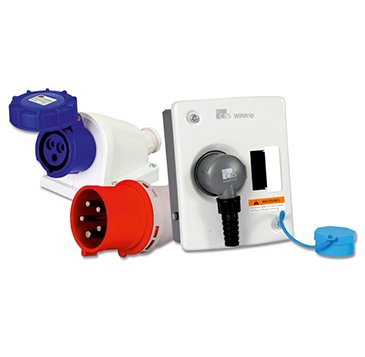
Walk around any UAE construction site, warehouse or port and you will see them. Chunky blue and red connectors sit on generator panels and site distribution boards. They are industrial plugs and sockets built to the international standard IEC 60309, and every part of their design tells you something.
First, the colour gives the voltage. Then the position of the earth pin stops the wrong plug going into the wrong socket. The seal and locking ring tell you whether it will survive rain or a hose-down. Once you can read those signs, ordering the right part takes minutes.
Why sites need industrial connectors
A domestic socket is fine for a kettle. But it was never designed for a 400 volt welder on a dusty site, or for a pump that gets hosed down every evening. Industrial connectors are tougher and lock in place. They are also keyed, so a 400 volt plug physically cannot enter a 230 volt socket.
The colour code
Under IEC 60309, the colour of the housing shows the voltage range.
| Colour | Voltage range | Typical use |
| Yellow | 100 to 130 V | Reduced-voltage site tools |
| Blue | 200 to 250 V | Single-phase power: lighting, site cabins, small machines |
| Red | 380 to 480 V | Three-phase power: welders, compressors, pumps, cranes |
| Black | 500 to 690 V | Heavy industrial and marine equipment |
Other colours also exist for special cases. Violet and white mark extra-low-voltage connectors, and green is used for supplies at higher frequencies.
Mains power in the UAE is 230 V single-phase and 400 V three-phase, so blue and red are the two you will order most.
The clock position of the earth pin
But colour is only half the story. Look at a socket face-on and imagine a clock. The earth pin is always the largest pin. It sits at a set hour, and that hour changes with voltage and frequency.
Standard 230 V and 400 V connectors put the earth at 6 o’clock, while 110 V connectors put it at 4 o’clock. Refrigerated containers use 3 o’clock, which is why a reefer socket at a port will not accept an ordinary red plug.
The practical rule is simple. Colour, pin count and clock position must all match, and if a plug needs forcing, it is the wrong plug.
Pin count and amp ratings
The number of pins tells you what kind of circuit the connector serves.
| Pins | Written as | Circuit |
| 3 | 2P+E | Single-phase: live, neutral and earth |
| 4 | 3P+E | Three-phase without neutral, common on motors |
| 5 | 3P+N+E | Three-phase with neutral, common on distribution boards |
Industrial plugs and sockets come in four standard current sizes: 16 A, 32 A, 63 A and 125 A. The pins get bigger as the rating rises, so a 16 A plug will not fit a 32 A socket.
Size the connector to the circuit breaker and the cable, not to what the machine usually draws. An undersized connector runs hot at the contacts long before anything trips.
IP44 or IP67?
The IP rating describes protection against dust and water.
IP44 connectors are splash-proof, so they suit indoor use and sheltered outdoor spots where rain or a splash might reach them.
IP67 connectors are watertight. A rubber gasket and a twist-lock ring seal the plug and socket together, so they can take heavy rain, hose-downs and even brief immersion. Jet-proof IP66/IP67 versions also exist for high-pressure cleaning.
Gulf sites see fine dust for most of the year, so we lean towards IP67 for anything that lives outdoors. The price difference is small next to a failed connector and a stopped site.
Plugs, sockets and connectors
The names are easy to mix up, because suppliers use them loosely. A plug goes on the end of the cable coming from the equipment. A socket outlet is fixed to a wall, panel or distribution board, and panel-mounted sockets sit flush in an enclosure.
A connector, sometimes called a coupler, is a socket on the end of a cable. People use it to extend a lead. An appliance inlet is the fixed male part built into the equipment itself.
How to order industrial plugs and sockets
Six details are enough for any supplier to quote the exact part:
- voltage, which also decides the colour
- number of pins
- current rating: 16, 32, 63 or 125 A
- IP rating: IP44 or IP67
- type: plug, wall socket, panel socket or connector
- clock position, if it is anything other than the standard 6 o’clock
Buying industrial connectors in the UAE
Jazeera International supplies industrial plugs and sockets for factories, construction sites, warehouses and marine sites across the UAE. Send us the voltage, pin count, current and IP rating on +971 56 158 9555 and we will confirm availability and price.
Frequently asked questions
What do the colours on industrial plugs mean?
They show the voltage, so you can tell at a glance what a socket supplies. Under IEC 60309, yellow is 100 to 130 V, blue is 200 to 250 V and red is 380 to 480 V.
What is the difference between IP44 and IP67 sockets?
IP44 is splash-proof, while IP67 is watertight. The IP67 type has a seal and a locking ring, so it suits outdoor and wash-down areas.
Can I use a blue plug in a red socket?
No. The pins and the earth position are different, so they will not fit. That is deliberate, because a 230 V device on a 400 V supply would be badly damaged.
What is a commando socket?
It is a common name, mostly used in the UK, for IEC 60309 industrial plugs and sockets.