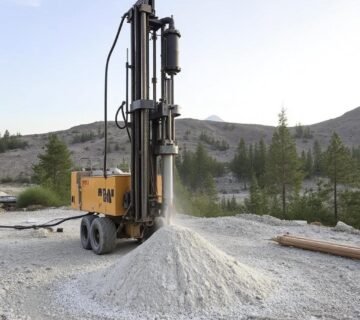
Waterjet cutting has become an essential fabrication technology across Qatar — used to cut steel, stainless steel, aluminium, stone, glass, composite materials and precision components for the oil and gas sector, construction, architectural fit-out and specialty manufacturing. The technology works by accelerating a fine abrasive in a high-pressure water stream to erode the workpiece at the cut line.
The abrasive choice has a direct impact on cut quality, pump life and operating cost. Some Qatar fabricators ask whether silica sand can substitute for garnet to reduce abrasive cost. This guide explains why garnet is the standard waterjet abrasive worldwide, what happens when silica is substituted and how to select the right garnet grade for Qatar fabrication applications.
How Waterjet Abrasive Works
In a waterjet cutting system, high-pressure water (typically 60,000 to 90,000 psi) accelerates through a small orifice into a mixing chamber where dry abrasive feeds in by gravity. Specifically, the abrasive accelerates to over 300 metres per second inside the mixing tube, then exits through a focusing nozzle to strike the workpiece. The combined energy of high-velocity water and hard abrasive particles erodes the material along the cut line.
Furthermore, the abrasive does the actual cutting work — the water is the delivery medium. Consequently, the hardness, density, particle shape and consistency of the abrasive directly determine cut speed, cut quality and how long the cutting system components last before requiring replacement.
Why Garnet is the Standard Waterjet Abrasive
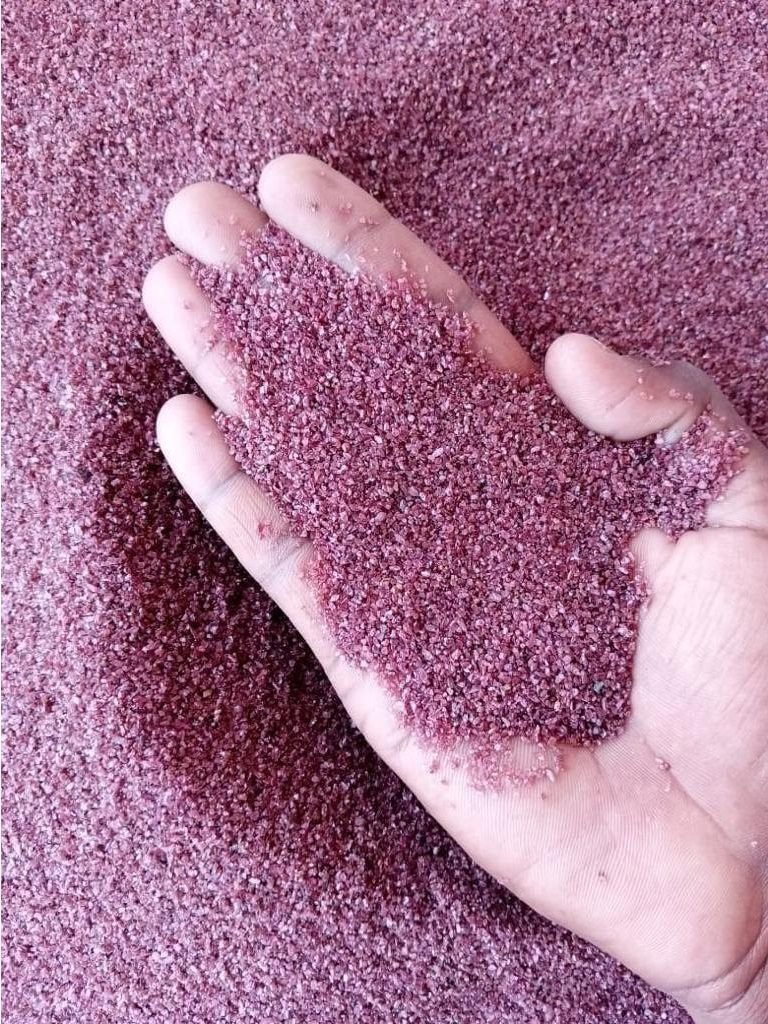
Garnet is used in essentially all industrial waterjet cutting worldwide. Specifically, almandine garnet has the right combination of properties:
- Hardness 7.5 to 8 on the Mohs scale — hard enough to cut steel and stone effectively
- Specific gravity 4.1 — heavy enough to transfer kinetic energy to the cut
- Sub-angular particle shape — sharp enough to cut, not so sharp it damages the focusing nozzle
- Consistent particle size distribution — predictable cut performance
- Low free silica content — meets workplace safety regulations
- Inert chemistry — does not react with workpiece materials
Why Silica Sand Fails as a Waterjet Abrasive
Silica sand has several properties that make it unsuitable for waterjet cutting:
Lower Hardness
Silica sand hardness is 7 on the Mohs scale versus 7.5 to 8 for garnet. Specifically, this small difference means significantly slower cut speed on steel and stone — typically 30 to 40 percent slower than garnet at the same flow rate.
Lower Specific Gravity
Silica specific gravity is 2.65 versus 4.1 for garnet. Furthermore, the lighter particles carry less kinetic energy to the cut surface — reducing cutting effectiveness even before hardness differences are considered.
Premature Nozzle Wear
Silica sand contains sharp angular particles that aggressively abrade the focusing nozzle inside the waterjet head. Specifically, focusing nozzles cost USD 200 to 500 each and normally last 80 to 100 cutting hours with garnet. With silica, nozzle life can drop below 20 hours — making the apparent abrasive saving disappear quickly through replacement parts cost.
Silicosis Risk
Silica sand releases respirable crystalline silica during waterjet operations — particularly during abrasive loading and waste handling. Moreover, this causes silicosis. Qatar workplace safety regulations and international standards prohibit silica sand in many industrial applications for exactly this reason. Garnet contains less than 1 percent free silica and is the compliant alternative.
Garnet Mesh Size Selection for Qatar Fabrication
80 Mesh — The Standard Waterjet Garnet
80 mesh garnet (180 micron average) is the most widely used waterjet abrasive across Qatar fabrication shops. Specifically, this mesh size gives the best balance of cut speed, cut quality and consumable life for general-purpose steel and stone cutting. Additionally, every major waterjet machine manufacturer specifies 80 mesh as the default operating abrasive.
120 Mesh — Finer Cuts and Detail Work
For precision architectural work — intricate stone inlay, glass tile patterns, fine logos and signage — 120 mesh garnet (125 micron average) gives finer detail at slower cut speed. Moreover, Qatar architectural fabricators serving Lusail City and Doha luxury development projects commonly stock both 80 and 120 mesh garnet to handle different cut requirements within the same workshop.
50 Mesh — Heavy Cutting and High-Speed Production
For high-throughput production cutting of thick steel plate, 50 mesh garnet (300 micron) gives faster cut speed at the cost of rougher cut edge. Specifically, fabricators supplying structural steel components to Ras Laffan and Mesaieed infrastructure projects use 50 mesh for primary cutting then finish detail work with finer mesh as required.
Where to Buy Waterjet Garnet in Qatar
Jazeera International supplies 80 mesh, 120 mesh and 50 mesh almandine waterjet garnet to fabrication workshops, architectural fit-out contractors and industrial cutting operations across Qatar — Doha, Ras Laffan, Mesaieed and Lusail. We source from certified Rajasthan processing facilities and deliver to Hamad Port in 3 to 5 working days from our Dubai warehouse.
Frequently Asked Questions
Q: Why is garnet better than silica sand for waterjet cutting?
A: Garnet has higher hardness (7.5 to 8 Mohs vs 7 for silica), much higher density (4.1 vs 2.65 specific gravity) and a particle shape that cuts effectively without aggressive wear on the focusing nozzle. Silica sand cuts 30 to 40 percent slower than garnet and shortens focusing nozzle life from 80+ hours to under 20 hours — making it more expensive overall despite the lower per-tonne price. Silica also releases respirable silica dust which is prohibited in many industrial applications.
Q: What mesh size of garnet should I order for waterjet cutting in Qatar?
A: For most Qatar fabrication work, 80 mesh garnet (180 micron average) is the standard. It is the default specification for all major waterjet machine brands and gives the best balance of cut speed, cut quality and focusing nozzle life. For finer detail work and architectural cutting, also stock 120 mesh. For thick plate high-throughput cutting, 50 mesh is faster but leaves a rougher edge.
Q: Can I reuse waterjet garnet?
A: Some fabricators recycle waterjet abrasive — collecting used garnet from the catch tank, drying it and sieving out fines. Recycled garnet typically gives 60 to 70 percent of the cut performance of fresh material and is unsuitable for precision work. For most Qatar fabricators, the labour and equipment cost of recycling exceeds the abrasive saving — single-use fresh garnet at consistent quality is more cost-effective.
Q: How fast can waterjet garnet be delivered to Qatar?
A: Sea freight from Dubai to Hamad Port in Doha takes 3 to 5 working days. For ongoing production fabrication operations, we set up standing monthly delivery arrangements with pre-agreed pricing — removing per-order administrative time. Container load quantities give the best per-tonne pricing for fabricators consuming above 5 tonnes per month.