Foundry managers and induction furnace operators face one critical decision at the start of every new furnace lining campaign: which ramming mass to use. The two main options — silica-based (acidic) and magnesia-based (basic) — perform very differently depending on what metal you are melting, what slag chemistry you operate and what temperature you reach.
Choosing wrong means short lining life, higher per-tonne refractory cost and unplanned furnace downtime. This guide explains the technical differences between silica and magnesia ramming mass, when to use each one and how to match the grade to your specific melting application.
What Ramming Mass Does
Ramming mass forms the working lining of coreless induction furnaces. Specifically, operators pack the dry granular refractory between the furnace coil and a steel forming mould, then sinter it at high temperature so the particles bond into a hard, heat-resistant ceramic layer. This lining contains the molten metal — typically at 1400 to 1700 degrees Celsius — and protects the copper induction coil from direct contact with molten steel, cast iron or non-ferrous metals.
Furthermore, the lining gradually erodes during normal operation through chemical attack from molten metal and slag, thermal stress from heating and cooling cycles and mechanical wear from charging operations. When lining thickness reaches the safety minimum, the furnace is shut down and relined. A good ramming mass extends time between relinings — directly reducing refractory cost per tonne of metal produced.
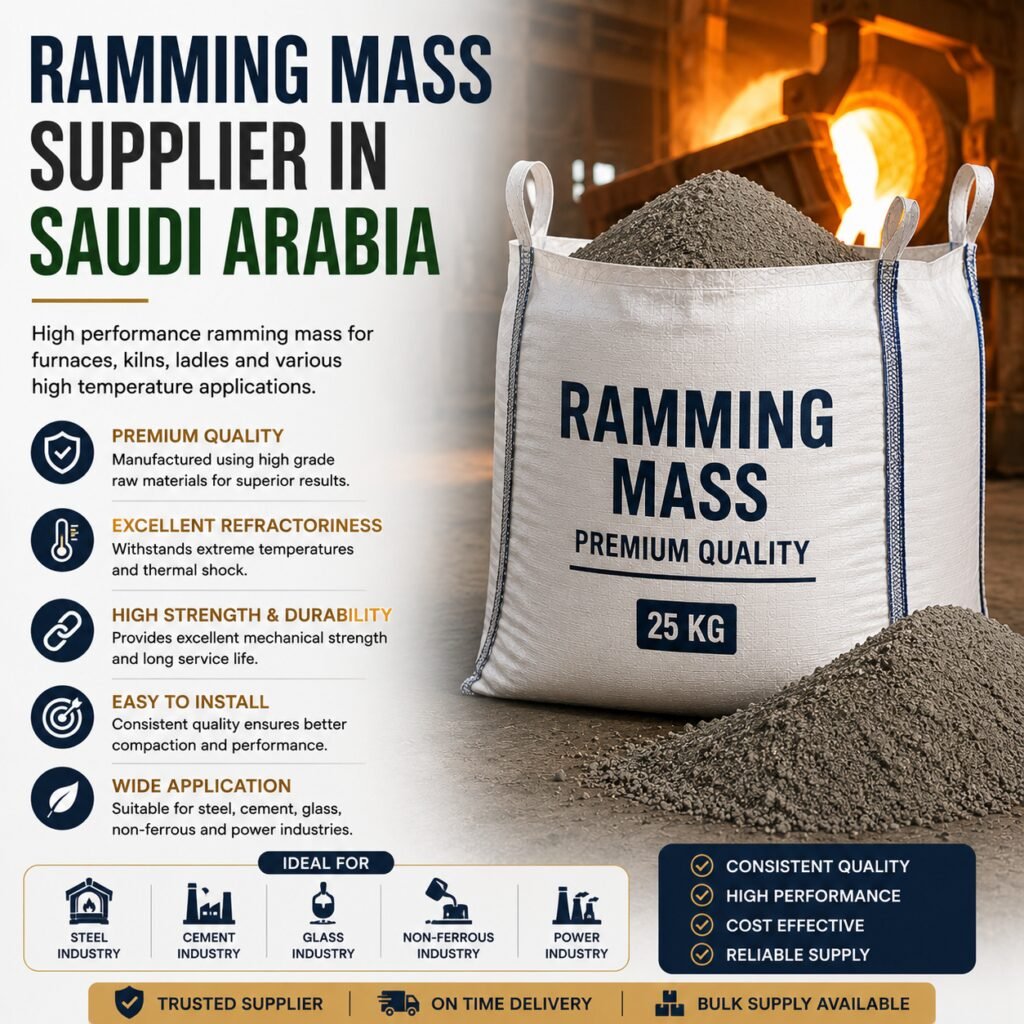
Silica Ramming Mass — Acidic Lining
Composition and Properties
Silica ramming mass is made of high-purity quartz — typically 97 to 99 percent SiO2 (silicon dioxide). Specifically, during sintering at furnace operating temperature, the quartz transforms through three crystal phases: quartz to tridymite to cristobalite. This phase transformation causes the lining to expand slightly, which closes pores and creates a dense, strong working layer.
Moreover, silica ramming mass uses a small percentage of boric acid as a sintering additive — typically 0.5 to 1.5 percent. The boric acid lowers the temperature at which the silica grains bond together.
Best Applications for Silica Ramming Mass
Silica is the standard choice for:
- Cast iron melting — grey iron, ductile iron, malleable iron
- Carbon steel melting where slag chemistry is acidic or neutral
- Low-alloy steel where alloy content does not require basic slag
- Most general-purpose foundry operations across Saudi Arabia and the GCC
Limitations
Silica linings perform poorly with basic slags — slags rich in lime (CaO) or magnesia (MgO). Additionally, the basic slag chemically attacks the acidic silica, eroding the lining rapidly. Furthermore, silica linings have a maximum service temperature of approximately 1680 degrees Celsius — above this point the lining softens and fails.
Magnesia Ramming Mass — Basic Lining
Composition and Properties
Magnesia ramming mass uses dead-burnt magnesia (MgO) as the primary refractory material — typically above 90 percent MgO. Specifically, dead-burnt magnesia is sintered at extremely high temperatures (above 1800 degrees Celsius) during manufacture, producing a dense, chemically stable refractory grade that resists attack from basic slags.
Best Applications for Magnesia Ramming Mass
Magnesia is the right choice for:
- Stainless steel melting — austenitic, ferritic and martensitic grades
- High-alloy steel — manganese steel, high-chromium grades
- Specialty alloys requiring basic slag chemistry for desulphurization
- High-temperature applications above 1700 degrees Celsius
Limitations
Magnesia ramming mass costs significantly more per tonne than silica — raw material cost is the primary difference. Specifically, foundries running cast iron or basic carbon steel waste money using magnesia where silica would perform equivalently at lower cost. Additionally, magnesia linings are more sensitive to thermal shock — rapid temperature changes can cause cracking. This means start-up and shut-down procedures need to be carefully controlled.
Decision Framework — Which to Choose
Use this framework to decide between silica and magnesia ramming mass:
- Cast iron melting? → Silica every time
- Plain carbon steel with acidic or neutral slag? → Silica
- Stainless steel? → Magnesia (the basic slag chemistry attacks silica)
- High-manganese or high-alloy steel? → Magnesia
- Service temperature above 1700°C? → Magnesia (silica softens)
- Non-ferrous melting (aluminium, copper, bronze)? → Consider neutral alumina ramming mass as a third option
Total Cost Comparison Beyond Per-Tonne Price
Silica ramming mass costs less per tonne, but the total cost depends on lining life. Specifically, in the right application, silica delivers excellent campaign life at low refractory cost per tonne of metal produced. In the wrong application, silica fails fast and the apparent saving disappears in shorter campaigns and lost production.
Moreover, magnesia in the right application — stainless steel, alloy steel — gives multiple times the lining life of silica in the same furnace. The higher per-tonne ramming mass price is paid back through fewer relinings, less downtime and lower total refractory cost. Furthermore, the correct selection should be based on total cost per tonne of metal produced, not unit price of ramming mass.
Sourcing Ramming Mass in Saudi Arabia
Jazeera International supplies acidic silica ramming mass, basic magnesia ramming mass and neutral alumina ramming mass to steel plants and foundries across Saudi Arabia — Jubail, Riyadh, Jeddah and Dammam. We import directly from certified processing facilities in Rajasthan with full Certificate of Analysis and technical data sheets for every shipment.
Frequently Asked Questions
Q: What is the main difference between silica and magnesia ramming mass?
A: Silica ramming mass (97 to 99 percent SiO2) is an acidic lining suited for cast iron and standard carbon steel melting at temperatures up to 1680°C. Magnesia ramming mass (above 90 percent MgO) is a basic lining suited for stainless steel, high-alloy steel and high-temperature operations up to 1750°C. The choice depends on the metal being melted and the slag chemistry, not just price.
Q: Why does silica ramming mass fail when melting stainless steel?
A: Stainless steel melting requires basic slag chemistry rich in lime (CaO) for desulphurization and inclusion control. The basic slag chemically attacks acidic silica refractory — magnesium and calcium in the slag react with silica to form low-melting compounds that erode the lining rapidly. Magnesia ramming mass is chemically compatible with basic slags and resists this attack.
Q: Is magnesia ramming mass worth the higher price?
A: For the right application — stainless steel, high-alloy steel, very high temperatures — yes. Magnesia in correct application gives 2 to 3 times the lining campaign life versus silica, which more than offsets the higher per-tonne price through reduced relining frequency and downtime. For cast iron and standard carbon steel, magnesia is unnecessary and wastes money — silica is the correct choice.
Q: What grain size of ramming mass should I order?
A: Most coreless induction furnaces use a blended grain distribution — typically 30 to 40 percent coarse (3-6mm), 30 to 40 percent medium (1-3mm) and 20 to 30 percent fine (below 1mm). Pre-blended grades labelled 0-3mm or 0-5mm work for most furnaces. Confirm the specific blend with your furnace manufacturer or refractory consultant — running the wrong distribution shortens lining life regardless of mineral quality.