Garnet Mesh Sizes Explained: 20/40, 30/60 and 80 Mesh Compared
Every garnet order starts with the same question: which mesh? Get it right and the abrasive does exactly what the coating spec or the cutting machine needs. Get it wrong and you either waste money on a grade you did not need, or fail a surface profile inspection and blast the whole job again.
The mesh system is simple once someone explains it. This is that explanation, plus a straight answer on which grade fits which job.
What Mesh Numbers Actually Mean
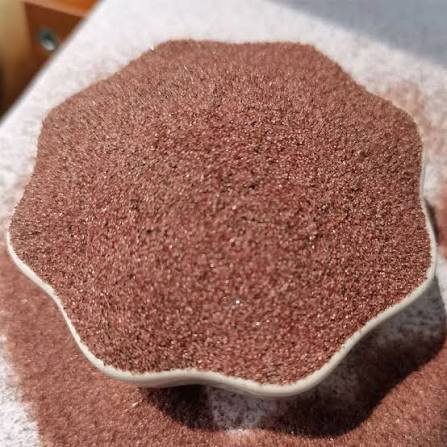
Mesh refers to the number of openings per linear inch in a test sieve. A 30 mesh sieve has 30 openings per inch; higher mesh number means smaller openings and finer particles. A dual designation like 30/60 means the particles pass through a 30 mesh sieve but are held on a 60 mesh sieve – so the grade contains particles between those two sizes.
In real measurements: 30/60 mesh garnet runs roughly 250 to 600 microns. 20/40 runs coarser at about 425 to 850 microns. Straight 80 mesh averages around 180 microns. The numbers on the bag are a particle size window, nothing more mysterious than that.
20/40 Mesh – The Heavy Cutter
The coarsest common blasting grade. Big particles carry more energy per impact, so 20/40 strips heavy mill scale, thick old coatings and rust fast. It leaves a deep surface profile of roughly 55 to 75 microns.
Use it for: initial blast of heavily corroded steel, thick multi-coat removal, structural steel that will receive high-build coating systems. Do not use it where the coating spec calls for a 40-65 micron profile – the deep anchor pattern will exceed spec and thin coatings will not cover the peaks.
30/60 Mesh – The Standard
If a blasting job in the Gulf specifies garnet without further detail, it means 30/60. This grade produces the 40 to 65 micron profile that most pipeline coating, tank lining and marine paint specifications call for, and it reaches Sa 2.5 near-white metal cleanliness efficiently.
It also recycles well – three to five cycles in a contained blast room before the particles break down too far. That recyclability is why garnet costs less per square metre than cheaper single-use abrasives, and 30/60 recycles better than any other grade because the particle size starts in the middle of the useful range.
80 Mesh – The Waterjet Grade
80 mesh is not a blasting grade. It is the standard abrasive for waterjet cutting machines, where fine consistent particles feed through the mixing tube and cut steel, stone, glass and composites. Every major waterjet manufacturer specifies 80 mesh as the default. Coarser garnet clogs the focusing nozzle; finer garnet cuts slower.
Fabricators doing fine detail work sometimes stock 120 mesh alongside it for intricate cuts, and high-throughput shops use 50 mesh for fast rough cutting of thick plate. But 80 mesh covers ninety percent of waterjet work.
Quick Selection Table
| Job | Grade | Profile / Result |
| Heavy rust and mill scale removal | 20/40 | 55-75 micron deep profile |
| Pipeline coating prep (NACE/SSPC) | 30/60 | 40-65 micron – matches most specs |
| Marine hull blasting | 30/60 | Standard for Sa 2.5 near-white |
| Tank internals, thin-film coatings | 30/60 or 30/80 | Controlled moderate profile |
| Waterjet cutting – general | 80 mesh | Standard for all machines |
| Waterjet – fine detail | 120 mesh | Slower, finer edge |
| Waterjet – thick plate production | 50 mesh | Faster, rougher edge |
The Mistake That Fails Inspections
The most expensive mesh mistake is using 20/40 on a job specified for a 40-65 micron profile. The blast looks fine to the eye, but the profile gauge reads 70+ microns, the coating inspector rejects the surface, and the fix is re-blasting with the correct grade – twice the abrasive, twice the labour. Check the coating data sheet for the specified profile range before ordering, not after.
Sourcing Garnet in the GCC
Jazeera International supplies 20/40, 30/60 and 80 mesh almandine garnet from certified Rajasthan processing facilities, with delivery across Saudi Arabia, Qatar and the UAE from our Dubai warehouse. Certificate of Analysis and grain size distribution report with every shipment.
Frequently Asked Questions
Q: What does 30/60 mesh mean for garnet?
A: The particles pass through a 30 mesh sieve (30 openings per inch) but are held on a 60 mesh sieve – so the grade contains particles between roughly 250 and 600 microns. It is the standard blasting grade in the Gulf, producing the 40 to 65 micron surface profile that most pipeline, tank and marine coating specifications require.
Q: Which garnet mesh is best for sandblasting?
A: 30/60 mesh for most work – it matches the 40-65 micron profile in most coating specifications and reaches Sa 2.5 cleanliness efficiently. Use 20/40 only for heavy mill scale and thick coating removal where a deeper 55-75 micron profile is acceptable. Always check the coating data sheet for the specified profile range before choosing.
Q: What mesh garnet is used for waterjet cutting?
A: 80 mesh is the standard for all major waterjet machines – fine enough to feed cleanly through the mixing tube, coarse enough to cut fast. Fabricators add 120 mesh for fine detail work and 50 mesh for high-speed cutting of thick plate, but 80 mesh handles the large majority of waterjet applications.
Q: Can blasting garnet be reused?A: Yes, in contained blast rooms. 30/60 mesh garnet typically recycles 3 to 5 times before particles break down below useful size – which is the main reason garnet costs less per square metre blasted than cheaper single-use abrasives. Open-air blasting without recovery gets one use. Waterjet garnet is generally single-use; recycling it costs more in labour than it saves.